 news
Admin · 2026-11-08 13:45 · edited
Photography in Pursuit of Perfection: How the Visual Language Is Changing in 2026 and What to Expect in 2027
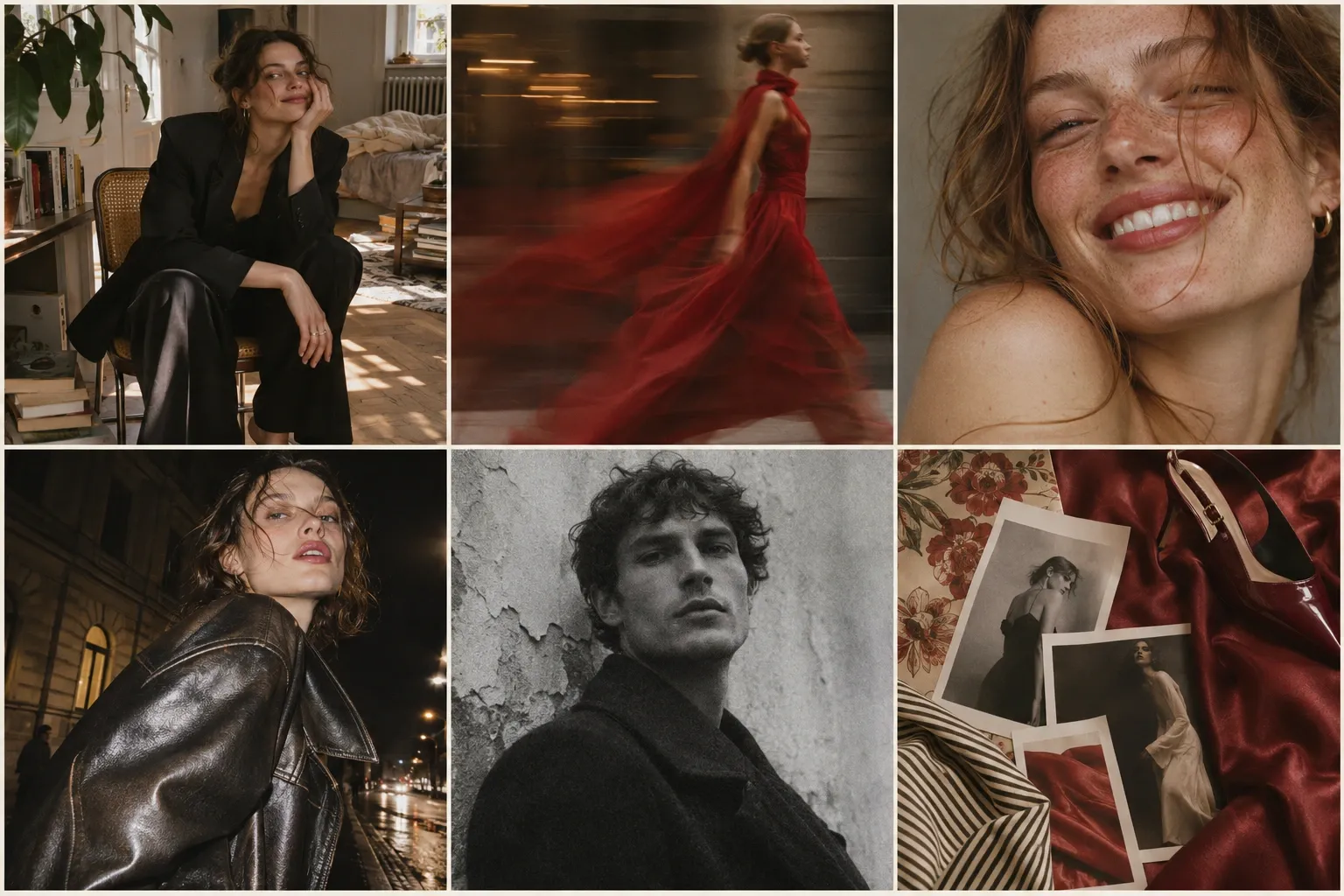
In an age when it’s possible to create a flawless image even without a photo shoot, photographers must answer the question with ever-greater precision: What does this frame convey, evoke, and reveal about this particular person? Technical quality remains important. But that alone isn’t enough to make a piece of work stand out.
The language of fashion photography has never been static. One campaign may be dominated by perfectly controlled studio lighting, while another features harsh flash, movement, or an everyday setting. The coexistence of these approaches becomes particularly interesting now that generative artificial intelligence has joined the camera as a tool for creating images.
A source of discussion is an Instagram post by Igor Caplin, a photographer and marketing and positioning specialist, about trends for 2026–2027. In the post’s description, the author notes that he reviewed more than 100 magazines. In a carousel of eleven images, he highlights deliberate disorder, unusual lighting, blurred motion, human emotions, flash photography, the aesthetics of analog photography, a provocative mood, collages, and the combination of various textures. In conclusion, he emphasizes the importance of emotional impact and offers his own teaching materials. [1]
This is the author’s interpretation, not a representative industry study. The post does not include a complete list of publications, the selection methodology, or a breakdown of trend frequencies. Therefore, it serves as a good starting point for a professional discussion but is an insufficient basis for concluding that the entire photography industry is moving in a single stylistic direction.
What Is Really Changing: Authenticity Is Becoming More Concrete
In Getty Images’ 2026 VisualGPS report, authenticity is linked to concreteness: an image requires a convincing context of people, places, and experiences. This is a valuable distinction. The impression of spontaneity can be staged, but a life situation familiar to the viewer cannot be replaced by a visual effect alone. [2]
For the photographer, this means choosing more carefully what to include in the frame. In a portrait of a businessperson, the work environment can help reveal their relationship with their profession. In family photography, interaction can convey more than a series of uniformly arranged poses. In a fashion story, a person’s gesture or a distinctive feature of the space can become the key to the entire series.
However, a seemingly natural shot can be very carefully staged. This in itself is not a flaw: in advertising and editorial fashion photography, staging is part of the job. It’s important to understand the difference between a credible visual story and a documentary-style record of an event.
Imperfection works when it serves a purpose
Sharpness, a clean background, and even lighting are tools. Blur, sharp contrast, or a broken composition are also tools. None of these automatically makes a photo good.
The result is the best way to distinguish a professional choice from a mistake. Does motion blur help convey a sense of rhythm? Does a darkened portion of the face create the desired mood? Does the framing direct attention to what’s essential? If the answer is clear, deviating from standard technical norms can be justified. If the effect merely masks a weak idea, it won’t save the work.
A practical solution is to create both reliable base material and an experimental series within a single photo shoot. For example, first take a precise image of the product with legible labeling, and then an emotional interpretation featuring reflections or movement. In this way, creative experimentation finds its place alongside the client’s functional needs.
Emotion and tangibility—a broader signal beyond a single photographic style
Adobe’s 2026 creative trends forecast highlights emotional connection, visually evocative imagery, and local cultural context. At the same time, there is also room for surreal, AI-generated ideas. Thus, humanity and technological experimentation can coexist. [3]
In photography, these trends can be interpreted in various ways. Texture can be revealed through side lighting, close-ups, and a careful selection of materials. An emotional connection can be created through relationships between people, a gaze, or a situation that the audience recognizes. A sense of local character can be conveyed through the real environment, clothing, and details that hold significance in a specific place.
Latvian creative professionals have the opportunity here to draw on what they know from experience: our light, our homes, people’s customs, and the character of our cities. An internationally understandable image does not lose its value simply because it incorporates the identity of a specific place.
In beauty photography, individuality requires precision
Getty Images’ review of the visual language of beauty points to a greater focus on individuality, personality, and a more diverse portrayal of people. This provides a basis for discussing alternatives to a uniformly idealized image of beauty. It does not prove that retouching or classic beauty advertising has disappeared. [4]
A natural depiction of skin is not simply a matter of eliminating retouching. It begins with harmonizing lighting and makeup. Lighting that is too harsh can produce a result that one later tries to smooth out excessively. In contrast, deliberately chosen contrast and a well-considered makeup texture allow the skin’s natural character to be preserved.
The model also plays an active role in this approach. A small gesture, a breath, a shift in gaze, or a reaction to a partner can yield a more convincing result than a repeated pose. The photographer’s task is to create a situation and provide clear direction so that these reactions are possible.
The Energy of Fashion: More Than Just a Statement About the Return of Rock ’n’ Roll
A concrete, verifiable example is Burberry’s Summer 2026 campaign. In its official description, the brand emphasizes the connection between fashion and music, self-expression, and the energy of the United Kingdom’s music scene. Sam Rock is credited as the campaign’s photographer. [5]
This example helps to substantiate a discussion about the presence of music culture in fashion communication. However, one cannot conclude from a single campaign that all luxury brands opt for the same kind of provocation or that such an aesthetic has a single social cause.
When crafting a fashion narrative, it is more useful to define a specific energy: the tension of the stage, the bravado of youth, the atmosphere of the city at night, or an intimate behind-the-scenes moment. Such a concept gives the team much more direction than a general assignment to photograph “boldly.”
Grain, flash, and collage are not a guarantee of authenticity
Visual aesthetics and the origin of an image have different meanings. A grainy photograph can be taken digitally and edited. A seemingly analog image can be generated. Conversely, a very clean studio portrait may be entirely based on a real photo shoot.
Therefore, it is not reasonable to consider a flash, light leaks, blurring, or the appearance of randomness as protection against AI replication. These are visual techniques, not reliable proof of how the work was created.
If a client or audience values actual photography, a transparent process helps explain this best: behind-the-scenes footage, a clearly identified team, and an honest description of the post-processing. These elements must also be evaluated in context; a single behind-the-scenes photo does not, on its own, reveal all the details of the final image.
Is minimalism over?
No—there is insufficient basis for such a general conclusion. In visual communication, both clarity of information and emotional impact are necessary. A clean composition may be suitable for comparing products, while a rich, detailed frame may be better for setting the mood of a campaign.
The choice depends on the audience, the publication venue, and the objective. An image that works brilliantly on a magazine spread won’t necessarily be suitable for a small ad on a phone screen. A bold combination of textures should also be evaluated in conjunction with the text, layout, and product visibility.
What to Take Away for Your Own Work
For photographers: Choose one creative concept and create a short, cohesive series. See how the story changes with movement, stronger lighting, or environmental details. Include in your portfolio those experiments whose quality you can reproduce in a commissioned project. Show the client both visual references and an explanation of how this approach will benefit their communication.
For models: Practice transitions between poses and the ability to act in specific situations. Exercises that require movement, reaction, or interaction with the space are useful. Your portfolio can showcase a range of skills—precise commercial work, emotional portraits, and motion-based fashion series.
For makeup artists: Before the photo shoot, agree on the desired skin tone, lighting style, and extent of retouching. Test the makeup under the lighting conditions in which it will be photographed. Build a portfolio that showcases both technical precision and the ability to preserve a person’s individuality.
For stylists and art directors: Align the number of textures, patterns, and props with the story. If everything in the frame is competing for attention, establish a clear focal point. Even deliberate disorder requires composition.
2027: The Style List Isn’t Ready Yet
In November 2026, we can only speak in terms of predictions about the dominant photographic aesthetics of the coming year. There is no basis for promising that a single technique will guarantee relevance, more commissions, or protection against technological changes.
A more reasonable working hypothesis is this: as the ability to quickly produce visually striking images grows, it is crucial for professionals to demonstrate their value through vision, collaboration, and the ability to achieve a specific result. A photographer must not only be able to create a beautiful shot but also explain why exactly that particular shot is needed.
Relevance begins with careful observation. A distinctive style emerges when what is seen is reflected upon, experimented with, and transformed into a personal, compelling work.